
A Conservative Adaptive Patchwise Boundary Integral Method for Shear Resistant Capsules in Confined Microvascular Stokes Flow
- Authors
-
-
Dmitry Sokolov
Department of Applied Mathematics, Pskov State University, Lenin Square 2, Pskov 180000, Russia
Author
-
Sergei Belov
Department of Physics, Yaroslav-the-Wise Novgorod State University, Bolshaya Sankt-Peterburgskaya Street 41, Veliky Novgorod 173003, Russia
Author
-
- Abstract
-
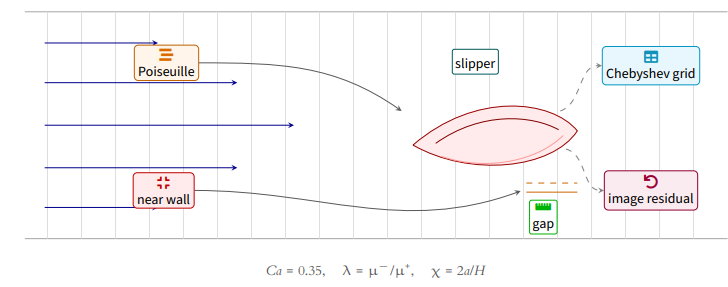
Microvascular transport is governed by a tight coupling between viscous stresses, membrane elasticity, geometric confinement, and numerical resolution of moving interfaces. Red blood cells and artificial capsules deform at length scales where inertia is negligible, yet their surface mechanics introduce stiffness and nonlocal hydrodynamic coupling that remain difficult to compute over long trajectories. This paper presents a high-order adaptive patchwise boundary integral method for three-dimensional shear resistant capsules in confined Stokes flow. The surface is represented by overlapping curvilinear charts with conservative metric reconstruction, local refinement driven by curvature and elastic strain, and a regularized single-layer quadrature coupled to a near-wall correction. The membrane model combines Skalak-type in-plane elasticity with a weak bending regularization and an area-volume correction treated through a projected constraint solve. A semi-implicit time integrator separates the nonlocal hydrodynamic mobility from the stiffest elastic modes without forming dense Jacobians. In manufactured-solution tests, the method achieves observed orders between 3.72 and 4.18 for velocity, force, area, and volume diagnostics. In confined Poiseuille flow at capillary number Ca=0.35, the adaptive discretization reduces degrees of freedom by 41% relative to a uniform patch grid at matched shape error. For low reduced volume capsules, the computed parachute-to-slipper transition occurs within a narrow interval of confinement and viscosity contrast, and the transition threshold shifts by 9\% when bending regularization is removed. The results suggest that conservative adaptive patch geometry can improve long-horizon capsule simulations while retaining a direct connection to boundary integral hydrodynamics.
- References
- Cover Image
-
- Downloads
- Published
- 2026-06-04
- Section
- Articles
- License
-
Copyright (c) 2026 International Journal of Scientific and Applied Computing Research

This work is licensed under a Creative Commons Attribution-NonCommercial-NoDerivatives 4.0 International License.
