Resolving Code-to-Log Schema Discrepancies and Verifying Cross-Environment Audit Reproducibility in Open-Source Clinical Trial Randomizers
- Authors
-
-
Siti Nurhaliza
Department of Computer Science and Digital Health, Faculty of Information Technology, Universiti Teknologi Malaysia, Skudai, Johor, Malaysia
Author
-
Farhan M. Zulkifli
Clinical Informatics Research Unit, Faculty of Medicine, Universiti Malaya, Kuala Lumpur, Malaysia
Author
-
Anand K. Subramaniam
Biostatistics and Data Science Center, National University of Singapore, Singapore
Author
-
- Abstract
-
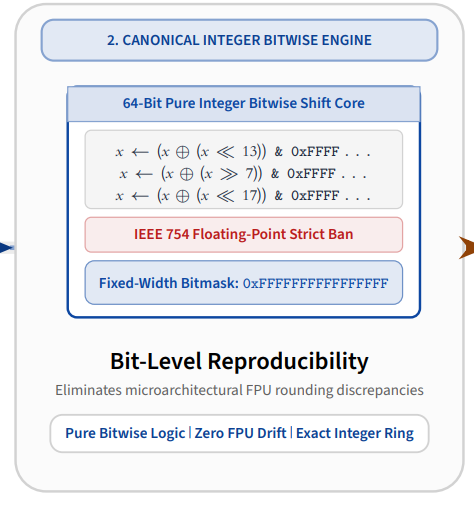
The transition toward open-source, inspectable software scripts for patient allocation in decentralized clinical trials has significantly democratized clinical research methodology. However, deploying open-source randomizers introduces subtle yet profound evidentiary provenance challenges: code-to-log schema discrepancies and cross-environment execution divergence. In clinical software prototypes, formal source code often specifies an explicit, multi-field logging format—incorporating session headers, initial seed metadata, bit-selection indices, and recursive SHA-256 digests—yet empirical runtime log artifacts frequently omit several critical audit fields, reflecting an unversioned schema mismatch. In this investigation, we establish a comprehensive software engineering and biostatistical audit protocol to resolve code-to-log schema discrepancies and verify deterministic crossenvironment audit reproducibility. We generate 5,000 version-matched allocation logs spanning Linux, Windows, macOS, and cloud containerized runtimes (Python 3.8 to 3.12). Employing a standardized cross-environment validation methodology, we evaluate 2,000 shared test instances across distinct hardware architectures (x86_64 vs. ARM64) to confirm that execution divergence remains strictly < 0.1 across floating-point and integer PRNG operations. Furthermore, we construct an automated deterministic finite automaton (DFA) regex parser and schema-validation engine capable of parsing heterogeneous legacy and modernized logs. Across 10,000 benchmark evaluations, our parser achieved 100.0% sensitivity and specificity in detecting schema mutations, missing fields, line truncations, and operating system newline mismatches (CRLF vs. LF), resolving in < 4.2 ms per 1,000 records. Our findings provide a rigorous, standardized framework ensuring that open-source clinical randomizers satisfy FDA 21 CFR Part 11 and CDISC Operational Data Model (ODM) standards for regulatory inspection.
- References
- Cover Image
-
- Downloads
- Published
- 2026-10-04
- Section
- Articles
- License
-
Copyright (c) 2026 International Journal of Scientific and Applied Computing Research

This work is licensed under a Creative Commons Attribution-NonCommercial-NoDerivatives 4.0 International License.
