
Invariant Extended Kalman Filtering and Shock-Decoupled Visual-Inertial Odometry for Bipedal Humanoid Locomotion on Perturbed Surfaces
- Authors
-
-
Ahmed Mostafa Sayed
Department of Mechanical Design and Production, Faculty of Engineering, Cairo University, Gamaa Street, Giza 12613, Egypt
Author
-
Mahmoud Tarek Abdel Rahman
Department of Computer and Systems Engineering, Faculty of Engineering, Ain Shams University, 1 El-Sarayat Street, Abbassia, Cairo 11517, Egypt
Author
-
Khaled Ibrahim Hassan
Department of Electrical Engineering, Faculty of Engineering, Alexandria University, Lotfy El-Sayed Street, Alexandria 21544, Egypt
Author
-
- Abstract
-
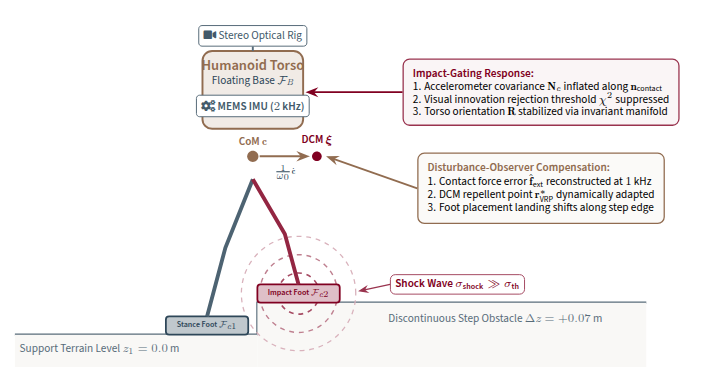
Precise six-degree-of-freedom base state estimation constitutes an essential prerequisite for feedback stabilization and balance preservation in autonomous bipedal humanoid robots traversing unstructured terrain. While visual-inertial odometry has achieved notable success across wheeled and aerial platforms, legged bipedal locomotion introduces high-frequency impact shocks, intermittent foot contact transitions, and severe torso sway that rapidly violate canonical constant-velocity motion priors and degrade visual feature tracking. This paper formulates an invariant extended Kalman filtering framework integrated with a shock-decoupled visual-inertial observer engineered specifically for full-sized humanoid robots navigating uneven and compliant surfaces. By casting the combined floating-base kinematics, forward joint velocity kinematics, and foot-ground contact state onto the matrix Lie group SE4(3), the proposed observer yields log-linear estimation error dynamics whose Riccati covariance updates remain strictly independent of the estimated trajectory operating point. To safeguard visual tracking against transient heel-strike and toe-off shock accelerations, an adaptive impact-gated innovation weighting module dynamically inflates measurement covariance along impulsive shock axes while preserving uncorrupted angular velocity and gravitational tilt cues. Simultaneously, a lumped disturbance observer extracts unmodeled terrain contact moments to supply feedforward stabilization offsets to an onboard divergent component of motion gait controller. Extensive closed-loop dynamic simulations and hardware-in-the-loop experiments on a twenty-nine degree-of-freedom humanoid platform demonstrate that the proposed invariant estimator reduces absolute translation drift to 0.68% over fifty-meter traverse paths, attenuates peak pitch-roll estimation oscillations by 61.3% under abrupt floor height steps, and maintains deterministic execution frequencies exceeding 500 Hz on embedded automotive-grade processing hardware.
- References
- Cover Image
-
- Downloads
- Published
- 2026-08-04
- Section
- Articles
- License
-
Copyright (c) 2026 International Journal of Scientific and Applied Computing Research

This work is licensed under a Creative Commons Attribution-NonCommercial-NoDerivatives 4.0 International License.
