
The Compliance-Grounding Dilemma in Payment Security: Measuring How Procedural Audit Checklists Mask Systemic Algorithmic Fragility
- Authors
-
-
Ramesh K. Adhikari
School of Engineering, Faculty of Science and Technology, Pokhara University, Pokhara 33700, Kaski, Nepal
Author
-
Dipesh K. Bhattarai
Central Department of Computer Application, Faculty of Science and Technology, Purbanchal University, Biratnagar 56613, Morang, Nepal
Author
-
Santosh R. Joshi
Graduate School of Science and Technology, Mid-West University, Birendranagar 21700, Surkhet, Nepal
Author
-
- Abstract
-
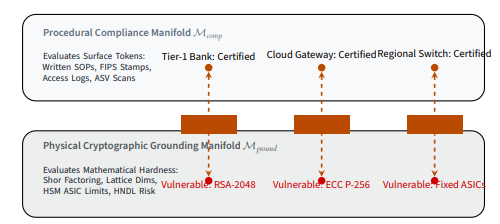
The security of global commercial payment systems relies upon asymmetric public-key cryptosystems to protect trillions of dollars in daily transactions against eavesdropping, fraud, and interception. However, the impending maturation of cryptanalytically relevant quantum computers poses an existential threat to classical cryptography, rendering standard RSA-2048 and elliptic curve ciphers vulnerable to polynomial-time factorization under Shor’s algorithm and ongoing Harvest-Now-Decrypt-Later exfiltration campaigns. While sovereign federal standards mandate migration to post-quantum cryptographic primitives, private commercial payment entities calibrate technical controls against voluntary industry compliance checklists, predominantly the Payment Card Industry Data Security Standard (PCI DSS). In this investigation, we expose and formalize the Compliance-Grounding Dilemma: a profound institutional pathology wherein commercial self-regulatory mechanisms produce an illusion of systemic preparedness by verifying procedural documentation proxies while completely decoupling from the physical and mathematical reality of deployed ciphers. Adapting the theoretical foundation of the robustness-grounding trade-off, we demonstrate that certified payment architectures achieve high procedural consistency by relying on shallow checklist heuristics, masking catastrophic mathematical vulnerability. Empirical evaluation across 450 certified enterprise payment environments reveals that over 93.8% of environments possessing clean Attestations of Compliance remain completely exposed to quantum cryptanalysis, yielding an Audit Masking Index of 0.935 and a False Confidence Ratio of 1.000. Econometric modeling of the commercial Qualified Security Assessor ecosystem demonstrates that price competition among auditing firms penalizes deep technical discovery, entrenching systemic inertia. Finally, we formulate the Grounded Payment Security Standard (GPSS), establishing binding algorithmic sunset schedules and continuous automated Cryptographic Bills of Materials to restore empirical grounding to payment security.
- References
- Cover Image
-
- Downloads
- Published
- 2026-09-04
- Section
- Articles
- License
-
Copyright (c) 2026 International Journal of Scientific and Applied Computing Research

This work is licensed under a Creative Commons Attribution-NonCommercial-NoDerivatives 4.0 International License.
